News
Menstrual Discrimination among Dalit Safai Karmachari Communities
Menstrual Discrimination among Dalit Safai Karmachari Communities
Radha Paudel1@ @Corresponding author 1-Founder/CEO-Global South Coalition for Dignified Menstruation, [email protected]
Abstract:
Along with menstruation an inevitable natural phenomenon, menstrual discrimination formed and passed from generation to generation since the emergence of menstruation in human history. Menstrual discrimination found all around the globe with various forms, names and magnitude though remained as ignored and sidelined. Manual scavengers who are associated with Safai Karmachari Andolan in New Delhi also are not exceptional for this. They are not only practicing discriminatory menstrual practices at an individual and family level but also imposed menstrual discrimination at their schools and workplace. They also have been practicing for the sake of get rid of from sin. While practicing various forms of menstrual discrimination, their human rights particularly right to dignity, right to equality, right to freedom and right non-discrimination violates multiple levels at once. Therefore, the stakeholders including government need to work on dignified menstruation where all menstruators could live equal, just society.
Key Words: Manual Scavenger, Dignified Menstruation, Patriarchy, Power, Exclusion
Background:
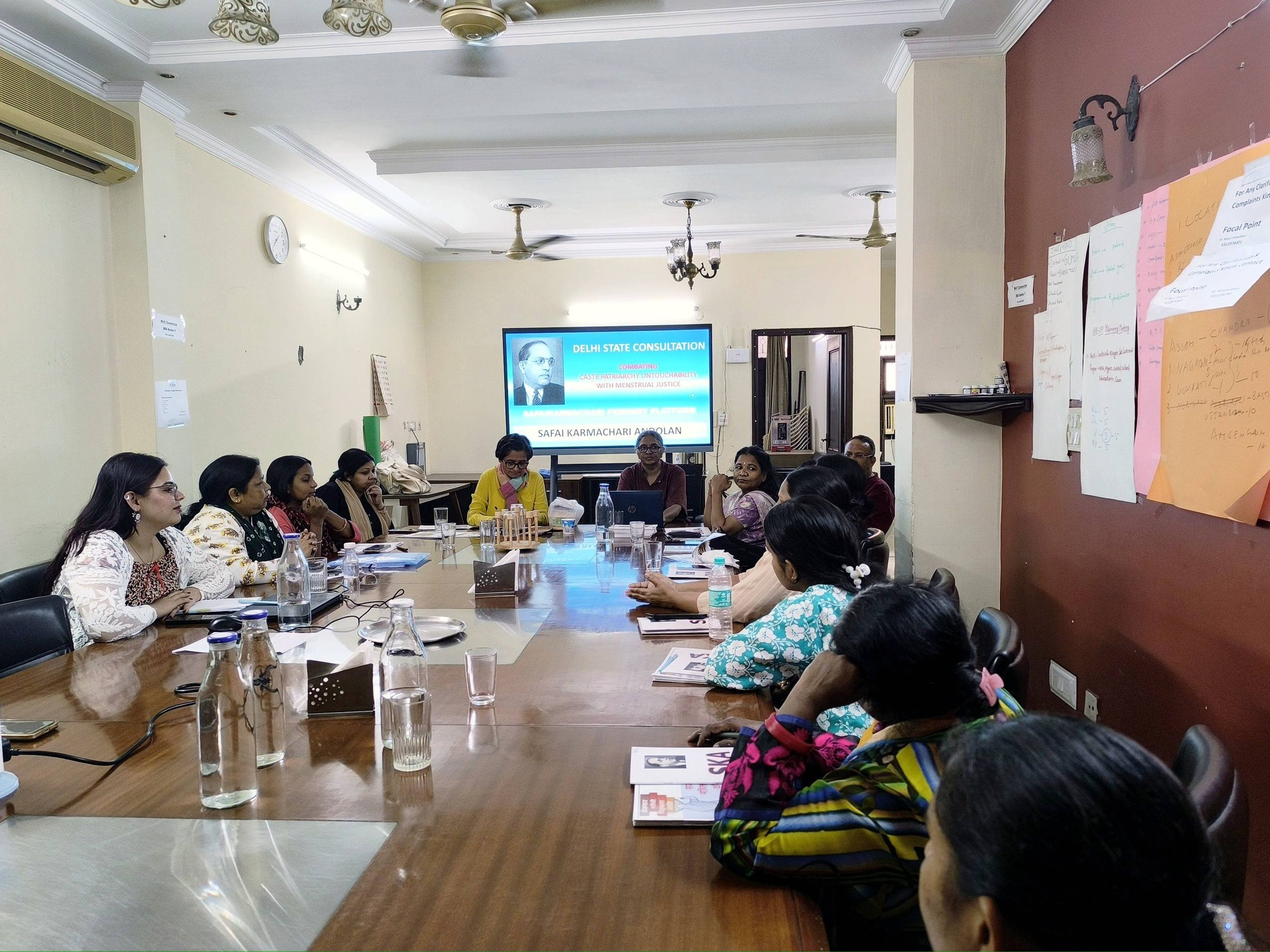
Since International Dignified Menstruation learning conference 8-10 December 2025, Kathmandu, GSCDM is more serious and passionate with the work of Safai Karmachari Andolan (SKA) and struggles of its comrades. It was clicked deeply due to the presence of Ms. Deepthi Sukumar, a National Convener, and board member of SKF in this conference that inspired GSCDM. Who hasn’t hurt by knowing this story? India have succeeded in sending human to moon and behaving her people in such bonded caste practice and that much humiliation. Even today, human engage in Manual Scavenge involves primarily so called `untouchable caste’ cleaning human excreta (yes, shit). Therefore, founder/CEO of it, Radha Paudel visited office of SKA in New Delhi, India in 13th March 2026. A day interaction program was organized by SKA with 16 participants where two were non-menstruators and 14 were menstruators. They shared their lived experiences, struggles around menstrual practices along with question-answer, storytelling, chanting slogans, songs etc.
Key Findings:
Menstrual Perceptions and Practices among Participants
Perception around Menstruation:
- Having menstruation is ready for marriage
- Menstruating person needs rest due to state of weakness
- Menstrual blood is impure and dirty
- Brahmin women considered untouchable while having menstruation,
- No talk in front of children about menstruation
- Menstrual blood has bad smell, dirty and impure
- Almost zero discussion around menstruation at home
- Only female members talk about it secretly
- Asked to wear toe rings, anklets and bangles for showing as more feminine
- Asked to not cut hair (keep long hair as femininity)
- Manage menstrual blood by hiding or secretly
Feelings during menstruation:
- Feeling broken, shyness, weak, strange, tired
- No interest to carryout regular activities
- Mood swings
- Lower abdomen/stomach pain
- Feeling dehumanized while in laws blamed as pretending expression against menstrual cramps
Restrictions on mobility:
- Not allow to play
- Do not allow/like to go outside of the home
- Not allow to go temple, no worship
- Personally, no problem but it is problem and have to follow the menstrual restrictions in front of grand parents
- Under surveillance of family all the time
- No cycling
- Asked to stay in separate room or place/corner at home
- Not allow to go to the school
- Asked to use sanitary pad (menstrual pad) after bath
- Not allow to go outside from house
Restriction on food:
- No touch and eat pickle and any sour foods
- Not allow to touch prasad (things offered to God during worship)
- Give food separately
Restriction on touch:
- Not allow to touch and worship Tulasi plant (considered as means of God)
- No mingling with brothers
- Do not allow to do make up during menstruation
- Change the cloth, use different or old/raged cloths
- Asked to cover body with long clothes
- Maintain distance with father and brothers
- Even not allow to touch Sopha while having menstruation
Menstrual Management:
- Silently manage menstrual blood
- After marriage, having menstruation is becoming complicated because of imposing many rituals
- Never seen pad, used cloth pad
- No dust bin
- Use double panty, double menstrual pad
- Limit water to drink in order to avoid frequently use of toilets
- Manage menstrual blood by hiding or secretly
Land lord imposes additional rituals/blames
- During menstruation, employer does more torture by imposing `do’ and `do not’.
- employer asked or checked whether we take bath or not after menstruation
- I have menstruation, because you invite menstruation here in my circumstances, land lady employer says.
- Not allow to speak at employers house once they know that we have menstruation
- They do not allow to cook food therefore recruit two housemaids. Having two housemaids applies to lower the renumeration
- Often, we do lie about our menstruation because of land lord’s additional layers of restrictions and discrimination
- If the woman at land lord have menstruation, we need to work double duty with same amount of renumeration
- Not allow to do program at Dharmashala (religious public space) due to our caste, several times organized meetings at parks
- Blamed to us as attitude women while we speak about our rights, our campaigns
- Blamed to us for informing their daughter in laws about rights
- Brother have more rights
- Boys know about menstruation from class at grade 8 or 9
- Menstrual restriction is in across all caste, religion
- Give food separately at land lord’s house once they know about the state of menstruation
- Even not allow to touch Sopha while having menstruation
Discussion:
- Poor or no knowledge about menstruation. Despite being brave and strong activists in SKA, participants are practicing discriminatory menstrual practices. According to the GSCDM (2019), they are not only subject to gender-based violence (GBV) but also cause and consequence of GBV e.g. child marriage. Most importantly, it is violation of human rights because they are following silence, taboos, stigma, restrictions related with food/touch/mobility, abuses, deprivation from services and resources that associated with menstruation.
- Menstrual discrimination promotes the unequal power relations, and patriarchy. Regardless of their identity (menstruator and non-menstruator), participants learned something about menstrual discrimination such as maintain distance with father and brothers, not sit on the sofa, not allow to do Tulashi Puja etc. since childhood in between 6-9 years of their age. Since then, menstruators considered themselves as inferior, powerless, weak and superior, powerful, strong for non-menstruators. Non-menstruators also considered same and socialize accordingly. Paudel, R., (2020) also claimed same where without possessing any other forms of power like class, money, position, muscle, the unequal power relationship, patriarchy and exclusion are socialized accordingly. Before applying any intersectionality, the menstrual discrimination remains as a common and first factor for inequalities and reinforcing patriarchy.
- Layers of human rights violation at work. As dalit manual scavengers, they have already lived in severe forms of caste discrimination and humiliation in many ways at work in both formal and informal work settings. Imposing menstrual discrimination is sorts of governing their body and dehumanize them deliberatively. Additionally, they subject with various forms of violation of human rights because of imposing menstrual discrimination. There are many examples on how do they experience violation of human rights (Global South Coalition for Dignified Menstruation, 2025). For instance, land lord recruit two house maid due to their status of menstruation and divide one’s the renumeration in to two of them. Likewise, few of the participants are at work by hiding menstruation or lying about menstruation which is also self-emotional torture and increasing vulnerability for accusation or physical beating by land lord.
- Practicing menstrual discrimination is more than violation of right to dignity. Because such discriminatory menstrual practices systemically and symptomatically violate the right to dignity, freedom, equality and non-discrimination at once. For instance, if the house maid pay by reduction the number of days of her menstruation or divide in to two house maids. They impose to live in more than derogatory conditions where their basic human rights more than dignity violated once. For the manual scavenger case, the severity is paramount in everyday life and impacts at personal, family and societal level.
- Menstrual discrimination is missing agenda in dalit rights movement. Menstruation is an inevitable natural phenomenon and exist in this universe since the time of homo sapiens or emergence of any philosophy or religion or theory. And all (Hindu, Buddhist, Christian, Muslim) religions considered that menstrual blood as an impure (Hüsken, U., Wittich, A., & Spina, N. R., 2024). But it is not discussed across all international normative human rights framework except commercialization point of view. This is how, the role of menstrual discrimination in construction of unequal power construction, patriarchy and exclusion also missing largely from local to global activism and vice versa. Therefore, the people who are marginalized are further pushed up to the margin of margin.
Recommendation:
- Evidence generation around gravity of menstrual discrimination is urgent therefore SKA need to employ multi-state research as earliest in order to protect human rights of its comrades.
- Incorporate the decolonial concept of dignified menstruation suggest in to policy and programming of SKA for dismantle patriarchy and creating equal and just society.
- Policy advocacy also needs to initiate from local to global and vice versa for guaranteeing the human rights of people who are struggling due to untouchability.
Acknowledgement: GSCDM express it deep gratitude and respect to Deepthi Sukumar, participants of interaction programs and entire SKA, new Delhi team for this opportunity. It was very insightful in many ways indeed.
References:
Hüsken, U., Wittich, A., & Spina, N. R. (Eds.). (2024). Gendered Agency in Transcultural Hinduism and Buddhism. Routledge, Taylor & Francis Group.
Paudel, R. (2020). Dignified menstruation, a practical handbook. Global South Coalition for Dignified Menstruation, Kathmandu
Global South Coalition for Dignified Menstruation. (2025). CEDAW GR 41: Menstrual discrimination is an underlying cause of gender stereotypes, systemic inequalities, and patriarchal power structures. Global South Coalition for Dignified Menstruation. Retrieved from https://www.dignifiedmenstruation.org/detail/169/cedaw-gr-41 menstrual-discrimination-is-an-underlying-cause-of-gender-stereotypes-systemic inequalities-and-patriarchal-power-structures Kathmandu
https://www.dignifiedmenstruation.org